
Why Your Toddler Doesn't Listen (It's Not Defiance): 4 Reasons and What to Do
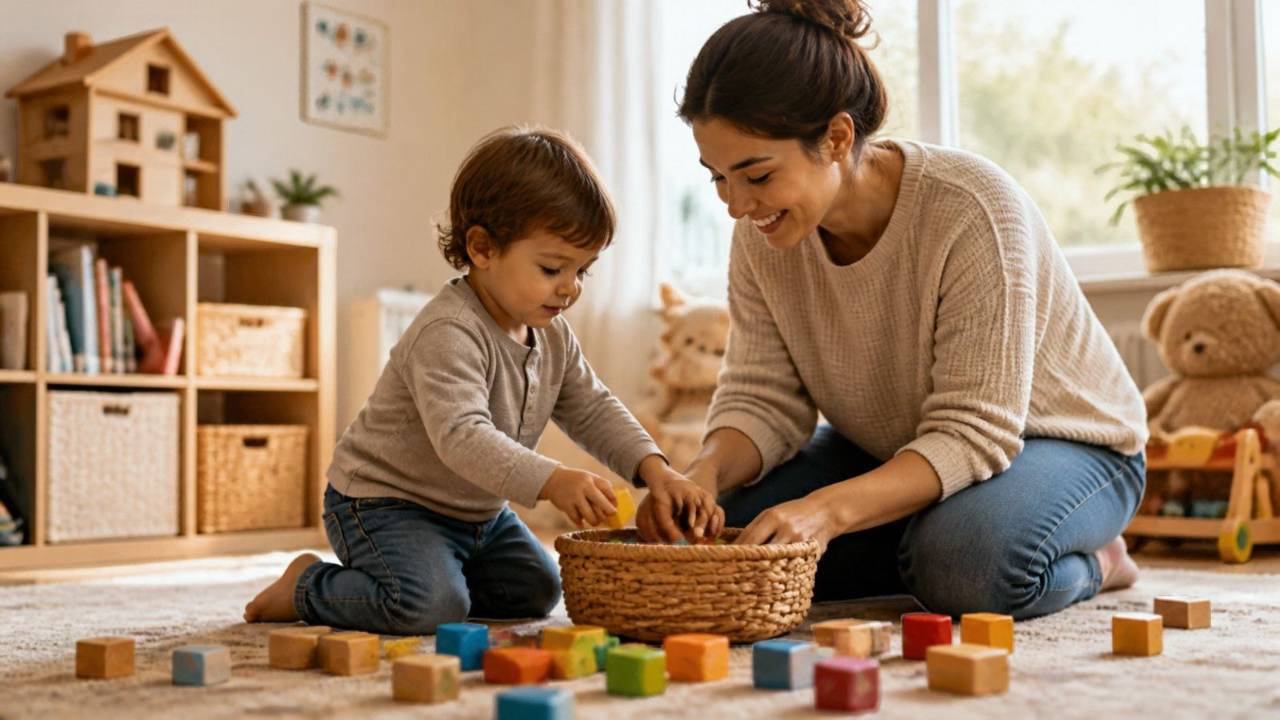
"Why won't my toddler listen to me?" I hear that question from parents every single week, usually right after a morning of repeating "get your shoes" six times and finally raising your voice. So let me start with the answer that surprises almost everyone: your toddler might be listening perfectly. The problem is often what we're saying and how we're saying it.
When a toddler doesn't listen, it's easy to read it as defiance. In nearly three decades of working in families' homes as a licensed clinical social worker and early childhood interventionist, I can tell you it usually isn't. A handful of things get in the way, some developmental and some things we do without meaning to. Once you know which one you're looking at, you'll know what to do instead of repeating yourself or getting louder.
The Clean-Up Question That Backfired
On a home visit, I watched this play out with a mom and her two-and-a-half-year-old son. It was time to clean up and head to the table for lunch. Mom, in the kindest voice you ever heard, said, "Do you wanna clean up your blocks?"
He looked right at her and said, "No."
Which, let's be honest, is a completely correct answer to the question she asked.
Then Mom said, "Come on, we have to clean up," and started putting the blocks away herself, moving his hands to help every now and then. I watched his whole little body deflate. It wasn't a tantrum. It was confusion. From his side, he was offered a choice, he answered it honestly, and his answer didn't count.
Mom was being polite, the way most of us were taught to be. But that tiny exchange, repeated 20 times a day, was teaching him something she never intended.
First, Rule Out Hearing
Before we talk about listening, you will want to rule out any other factors that may impact your little ones ability listen — specifically, their hearing. Fluid behind the eardrum is extremely common in the toddler years. Most children have had it at least once by the time they're four. And here's what makes it so easy to miss: unlike an ear infection, it usually doesn't hurt. No fever, no tugging at the ear, just a mild hearing loss that comes and goes depending on how much fluid is sitting there.
That looks exactly like a child who listens sometimes and ignores you other times. So if your gut has ever said, "Something seems off with his hearing," ask your pediatrician to check it. That's the first thing I'd rule out with any little one who isn't listening.
Okay, hearing checked. Now let's talk about the real reasons. The first two are about how the brain is built. The last two are really about us.
Reason 1: His Brain Needs More Time Than We Give It
Toddlers are surprisingly fast at hearing words. Two-year-olds recognize familiar words almost as quickly as adults do. What's slow is everything that comes after. We're asking him to stop what he's doing, resist the strong pull to keep doing it, hold your words in mind, come up with a plan, and get his body to switch tracks.
That whole chain is called executive function, and in a two-year-old it's still under construction. So when he stands there for what feels like forever, he isn't ignoring you. He's assembling.
Here's the big picture part. That same machinery (stop what you're doing, hold the plan, switch tracks) is what lets a 15-year-old close the video game and open his homework. You're watching the earliest, clumsiest version of a skill your child will use for the rest of his life. Every time you give him the seconds to make that switch himself, he's practicing, and practice is what builds the skill.
Reason 2: His Working Memory Holds One Thing at a Time
Working memory is the mental space where we hold and process information, and in a toddler it's still very small. I like to picture it as cupping water in your hands. Adults can hold about three or four pieces of information at once before it spills. A toddler's hands are much smaller. He can hold one instruction. By about two and a half, maybe two, and that's close to the limit.
You say, "Get your shoes." He's holding that instruction and getting ready to move, which from the outside can look like nothing at all. So you repeat it: "Get your shoes. Get your shoes." Or you call his name to make sure he heard: "Buddy. Buddy. Buddy."
But he was listening. Every repetition hands him a new piece of information while his hands are already full. He loses the original instruction, and then he can't do anything. We interrupt the processing because it looks like he didn't hear us. He did. He just needed time to work it through.
Reason 3: We Ask Questions When We Mean Directions
Parents often phrase directions as questions because they’re trying to be polite and gentle, and they want to give their kids a sense of control. So instead of "It's time to clean up," they say, "Do you wanna clean up?"
When you ask a question you don't really mean, your child answers it. Usually the answer is no, because he'd rather keep playing or do literally anything else. He's telling you the truth.
For some perspective, consider this: If your boss asks, "Can you stay late tonight to finish this project?" you hear a real question. You think about your evening, and you might say no. But if she says, "I need you to stay late tonight and finish this," that's different. Her tone didn't change. She wasn't rude. You just know where you stand, and you're far more likely to stay.
Your toddler is doing the exact same math. He understood you. The question left the door open. And when we override his answer over and over, 20 times a day, what he learns is that his answer doesn't count, that being asked isn't real, and that our words don't mean what they say.
Reason 4: He's Trying to Close the Loop
This is the reason that ties everything together. Between about 18 months and three years, toddlers are in what psychologist Erik Erikson called the autonomy stage. Their drive to understand how the world works, and to see that their actions matter, comes roaring online.
He figures out the world by experimenting: repeating an action, watching what happens, trying to learn the rule. He's collecting data and trying to close the loop.
When we're inconsistent, the loop stays open. Say you tell him, "If you throw that again, we're going home." He throws it, and you're still at the park 20 minutes later. What did he learn? Not the rule. So he tests it again. And again.
All that testing looks like not listening. What's actually happening is that he's still collecting data, because the rule isn't clear yet. The good news is that the opposite is equally true. When you say something and make it true every single time, the loop closes, he stops testing, and that is completely within your control.
What to Do: Four Strategies
Strategy 1: Decide whether it's a direction or a choice
Before the words come out, ask yourself one question: is "no" an acceptable answer here? If it is, ask away. That's a real choice. If it isn't, because shoes are non-negotiable when you're walking out the door, don't phrase it as a question. Say it as a direction in a calm, steady voice: "It's time to get your shoes on now." Most listening battles in a house come down to non-negotiables wearing a question costume.
Strategy 2: Say it assertively
Assertive gets confused with harsh, so let me be clear. Passive is the question that isn't really a question. Aggressive is the raised voice, the countdown, the threat. Assertive sits in the middle: calm, clear and certain. "It's time to clean up the blocks." "We're changing your diaper now." Soft in tone, solid in words. You can be warm and immovable in the same sentence.
Two things make it land even better. Say what you want instead of what you don't want, because "Blocks go in the bucket" gives his brain a picture it can follow. And give one step at a time, because remember, his hands can only hold one. "Put your shoes by the door." When that's done, the jacket.
Strategy 3: Give him time on both ends
On the front end, give him a runway. "Two more minutes" means nothing to a two-year-old, because time isn't a concept he has yet. Make it something he can see or hear: a visual timer, an alarm on your phone, or one song that ends when it's clean-up time. Play is your child's work, and being yanked out of it has a cost. If someone pulled you away from the sink mid-dishes, you'd be irritated too.
On the back end, say it once and then be quiet. Count to 10 in your head. It will feel like an eternity, and you'll want to fill it. Don't. He's assembling, and every repeat makes him start over. In my experience, parents are genuinely surprised how often a child starts to move around second seven, right about when they were going to give up.
Strategy 4: Give choices in the how, then follow through
This strategy has two parts that work together. First, offer real choices inside the non-negotiable. The what isn't a choice. The how can be. "It's clean-up time. Do you wanna throw the blocks in like basketballs or line them up like a train?" You're holding the boundary and honoring the person in the same sentence.
Second, follow through every single time. If you offered a real choice, honor his answer. If you said one more turn, it's one more turn. If you said you'd leave if it got thrown again, you leave. That's how your words get their weight back.
One honest heads-up: if you've been phrasing a lot of directions as questions, he's used to that. When you start speaking clearly and meaning it, expect some pushback for the first couple of weeks. He's recalibrating to a version of you that says what she means and means what she says. Stay warm and stay consistent. Clarity feels different before it feels better.
What It Looked Like When It Clicked
Back to that mom and her son. She set a timer where he could see it and told him, "When the timer beeps, it's clean-up time." When it beeped, she asked do you want to toss the blocks in like basketballs or make them scoot like a train, and then she stopped talking and counted in her head. After several seconds, he said, "Basketball," and cleaned up just about every block. Was it magic? No. But nothing about the rule changed. Everything about the delivery did.
The Big Picture
The way we speak to our children right now trains how they'll relate to words for the rest of their lives: whether directions feel safe, whether "no" can be trusted, and whether the people who love them mean what they say. A toddler who learns that his parents' words are solid ground becomes a teenager you can actually talk to, and an adult who says what he means too.
I go deeper on all of this in the full video: https://youtu.be/tnL376JKEEU
If you want insights like this every week (practical, grounded in development and written for parents with real time limits), join my free weekly email here.
Quick Answers
Why doesn't my toddler listen to me? Usually it isn't defiance. The most common reasons are that his brain needs more time to switch tracks, he can only hold one instruction at a time, the direction was phrased as a question, or the rule hasn't been consistent enough for him to learn it. Rule out hearing first.
How do I get my toddler to listen without yelling? Say it once, calmly, as a direction rather than a question, then wait quietly for about 10 seconds.
All my best, Jill
Jill Urbane, LCSW, is an early childhood interventionist with nearly three decades of experience working in the homes of families with young children.
Hey!


